Mutual - Chaplin Specials

By Jeffrey Vance, adapted from his book Chaplin: Genius of the Cinema (New York, 2003) © 2009 Roy Export SAS

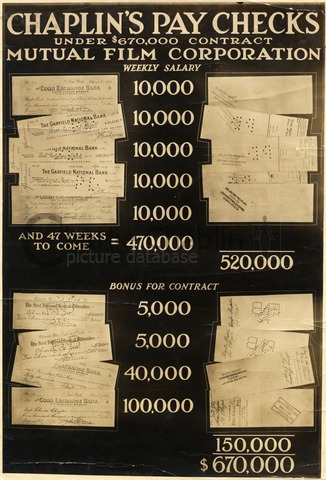
By 1916, just two years after appearing in his first motion picture, Charles Chaplin had become the most famous entertainer in the world. Buoyed by his enormously successful comedies for Keystone and Essanay, he was offered the largest salary ever extended to a motion picture star—$670,000 for a single year’s work—to make twelve two-reel comedies for the Mutual Film Corporation. For Mutual, Chaplin produced what many film historians believe to be his best works.
Few artists seminal to a medium leave a detailed history that charts the early evolution of their craft. Although the initial Mutuals have the feel and structure of Chaplin’s earlier, less sophisticated films, the progression of the series to the final four Mutuals is truly inspiring. Viewing the Mutual-Chaplin Specials is comparable to turning a camera on Thomas A. Edison in Menlo Park and capturing unhindered the inventor’s moments of pure inspiration. The thrill in watching nearly all of the Mutuals comes in the Promethean moment when Chaplin’s inventiveness intersects with his genius and produces cinematic comedy sequences unlike any before. The Mutuals are Chaplin’s laboratory, offering an unprecedented glimpse into the inner workings of the mind of a great cinema pioneer.
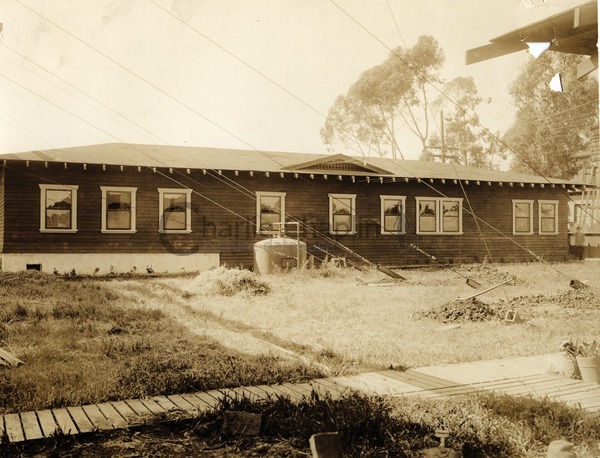
The Mutual Film Corporation created a subsidiary called The Lone Star Corporation solely to make the Chaplin films. Lone Star paid Chaplin $10,000 a week plus a $150,000 signing bonus for the twelve two-reel comedies. The unprecedented sum would set the standard for the salaries of motion picture stars. Indeed, Mary Pickford, known as “America’s Sweetheart,” did not allow Chaplin’s record-breaking salary to go unchallenged. The company provided Chaplin his own studio, named The Lone Star Studio. The facility was formerly the Climax Studios, located at 1025 Lillian Way in Hollywood, and later would be used by Buster Keaton to make all his independently produced silent two-reel and feature-length films. Chaplin made approximately one film a month but several required more time, and the series ultimately took eighteen months to complete. Although this may appear to be remarkably swift work, it was a leisurely pace compared to the speed he had been required to maintain at Keystone and Essanay.

The press and public were amazed and even skeptical at the amount of Chaplin’s earnings. A Mutual publicist wrote, “Next to the war in Europe Chaplin is the most expensive item in contemporaneous history.” (1) Chaplin was sanguine. “It means that I am left free to be just as funny as I dare,” announced Chaplin, “to do the best work that is in me…There is inspiration in it. I am like an author with a big publisher to give him circulation.” (2) Mutual provided Chaplin the freedom to explore all his comic ideas and to discard anything he believed failed to work on film.
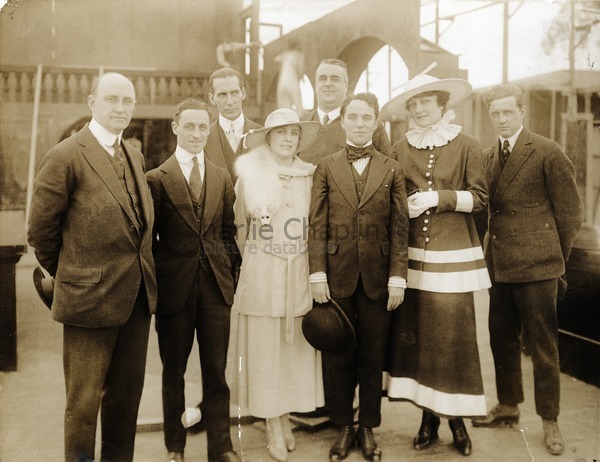
Henry P. Caulfield (succeeded by John Jasper in June 1917) produced the Mutual series. Chaplin chose William C. Foster as the first cameraman with Rollie Totheroh as his second (two negatives were made of each shot). Foster left the Lone Star Studio after four films, leaving Totheroh as head cameraman and George C. Zalibra as the second. Totheroh trained at Essanay, where he first met Chaplin. (He had played several seasons of minor-league baseball prior to working in films). From the Mutual period onward, Totheroh had a lasting professional association with Chaplin. He was cinematographer for every Chaplin film through Modern Times and remained on the Chaplin payroll until 1954. Totheroh’s tolerance of Chaplin’s volatility contributed to their long working relationship.

Totheroh’s cinematography has been criticized as unimaginative and static, but his work provided the director exactly what he wanted. Except for an occasional tracking shot in The Vagabond, The Count, Easy Street, and The Cure, the camera remained stationary to match Chaplin’s style of direction, which was intended to foreground his performance. Chaplin refined and altered the action over several takes, but he almost never changed camera position on a set-up.

“Placement of camera is cinematic inflection,” Chaplin wrote in his autobiography. “There is no set rule that a close-up gives more emphasis than a long shot. A close-up is a question of feeling; in some instances a long shot can effect greater emphasis.” Chaplin cited The Rink, his eight film for Mutual, as an example:

The tramp enters the rink and skates with one foot up, gliding into all sorts of mischief, eventually leaving everyone piled up on their backs in the foreground of the camera while he skates to the rear of the rink, becoming a very small figure in the background, and sits amongst the spectators innocently reviewing the havoc he has just created. Yet the small figure of the tramp in the distance was funnier than he would have been in a close-up. (3)
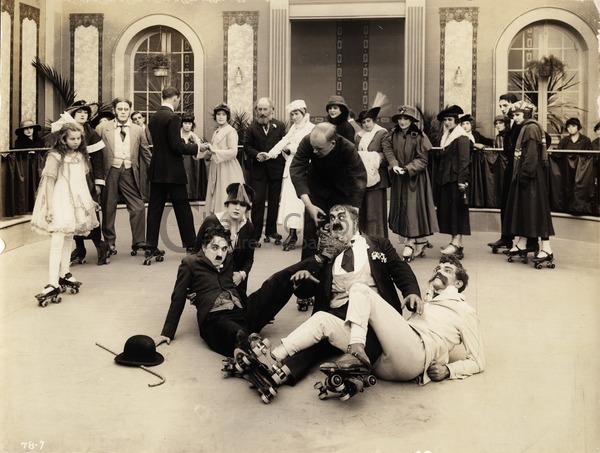
Indeed, he once remarked, “Life is a tragedy when seen in close-up, but a comedy in long shot.” (4)

Chaplin ordered Totheroh to film the action at an eye-level, full-figure distance or, for a medium shot, at a waist-high-figure distance, depending on what the scene demanded. Close-ups were seldom filmed. Similarly, Chaplin’s lighting was also basic, without any tricks or attempt at mood. His rudimentary approach to camera placement and lighting was a conscious decision to remain focused on the actors and to leave the performance area accessible for improvisation at all times. Moreover, complicated camera set-ups required time. When the mercurial Chaplin was ready to act, he did not want to be waiting on technicians. From his first film to his last, Chaplin remained a man of the theater, and his primary concern was to convey to the audience the action and the emotion of a scene through the performances of his actors, not through innovative or elaborate photography, lighting, or editing.
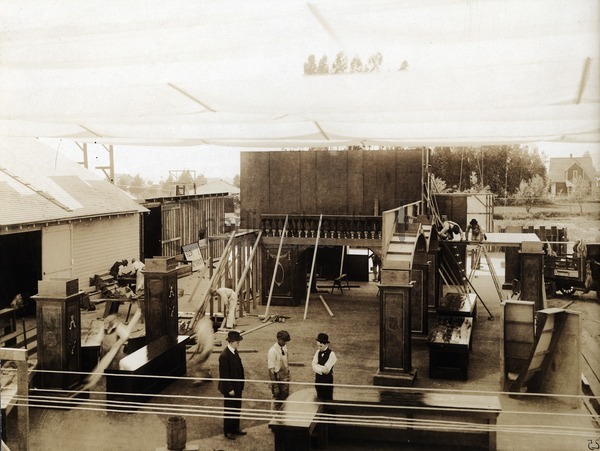
Chaplin’s method of filmmaking departed from that of most silent-film directors. First of all, he disliked filming on location and avoided it whenever he could, preferring the controlled conditions of his studio, which allowed him to insert scenes days or weeks later and have them match the master scenes. Moreover, Chaplin took too long to film anything substantial on location. In the silent era, just as today, every shot was given a separate number. Silent filmmakers did not utilize a clapperboard, which is useful for synchronizing action and sound, but a simple slate board to mark the scenes. Chaplin’s unorthodox system was to mark each take in chronological order rather than to assign a number to each scene. Eschewing formal scripts, Chaplin devised ideas for scenes in advance and had them typed up as notes. Often, however, inspiration would strike him on a set and there would be no time to have the notes typed.

By any standard, Chaplin’s directing style, perfected during the filming of the Mutuals and employed throughout the rest of his career, was unique in the cinema. He simply acted out the parts of all the actors as he wished them to be played, down to the slightest gesture of the hand or movement of the eyebrow. Chaplin and his cast would be in full costume and make-up while he rehearsed scenes and refined ideas over and over again on film. This directorial style was considered eccentric even in 1916, and the time he lavished on his films was the envy of every filmmaker. Yet for Chaplin, a laser-like concentration on performance and perfection to the exclusion of all else was his unyielding obsession, even until the end of his career.
Chaplin neither wrote about nor discussed his filmmaking methods at length. He felt, “if people know how it’s done, all the magic goes.” (5) However, despite Chaplin’s later orders to have the outtakes destroyed, an extensive amount of outtakes—primarily from the Mutual period—survives as a detailed record of his creative process. They reveal that Chaplin was willing to film a scene over and over again, even if he had an idea only partially worked out, until he was completely satisfied with the result. (6) Totheroh later recalled:

He didn’t have a script at the time, didn’t have a script girl or anything like that, and he never checked whether the scene was in its right place or that continuity was followed. The script would develop as it went along. A lot of times after we saw the dailies the next morning, if it didn’t warrant what he thought the expectation was, he’d put in some sort of a sequence and work on that instead of going through with what he started out to do. We never had a continuity. He’d have an idea and he’d build up. He had sort of a synopsis laid out in his mind but nothing on paper. He’d talk it over and come in and do a sequence. In a lot of his old pictures, he’d make that separation by using titles about the time: “next day” or “the following day” or “that night”--these would cover the script gaps in between. Charlie would rehearse them. He’d rehearse everybody and even in silents, we had dialogue. It came to a little woman’s part, and he’d go out there and he’d play it. He’d change his voice and he’d be in the character that he wanted the little old woman to play. He’d build their lines up and rehearse them, even before he rehearsed himself in it. He rehearsed so many darn different ways with them that when he came in there, it’d be changed all around with what he put down. You had to be on the alert for him.

I never got away from the camera, looking through that lens. And all those rehearsals, I sat right there, watching every move he made. Then if he came along and something spontaneous hit him, you had to be ready there to take it and get it. As a director, Mr. Chaplin didn’t have anything to say as far as exposures, things like that. Otherwise, I used to say, “Take a look through here.” The idea of that was that if he was directing, he’d have to know the field that I was taking in. Of course, in the early days, the role of the cameraman was much bigger than it is now. It was up to the cameraman to decide what angle to shoot for lighting; or outside, which is the best angle on a building or whatever it is. Then you have to figure what time of the day it would be better to shoot that shot, whether you want back-light or cross-light or whatever on your set. I had to keep the set pretty well lit. You couldn’t under light and get some nice shadows. No, Charlie wanted to look like a clown. He wanted that pretty near white face. And you had to watch out; you couldn’t have shadow over here or back of you because you never knew where he was going to work. You had to watch out and keep your eye out all the time.

On a typical day, we’d shoot from around eight or nine in the morning right straight through till lunch. Of course, this was before unions. And a lot of times he’d want to shoot two hours after dinner. After we’d break for lunch or for dinner, we’d start up again. I could always tell my set-ups because I was smoking Bull Durham and I used so many matches. You could see all these matches all over the floor. (7)

Chaplin created his own comedic sequences, although he was assisted on the Mutuals by a capable scenario staff. Vincent Bryan, a writer of vaudeville sketches and songs who had worked with Chaplin at Essanay, was chief scenario editor. Maverick Terrell was also engaged to assist Chaplin develop his ideas. As Terry Ramsaye wrote, “He surrounds himself with these interesting and gifted persons, not to have them do his work for him, but to supply gravel for his mental gizzard.” (8) Albert Austin also contributed comedy ideas, as did Chaplin’s elder half brother Sydney. Evidence from outtakes of films such as The Pawnshop shows that Chaplin also trusted Sydney to assist him in direction. Chaplin, who suffered from insomnia during this period of his life, also began to use a phonographic dictating machine by his bedside to record any comedy idea that occurred to him, a practice that would remain with him for many years.
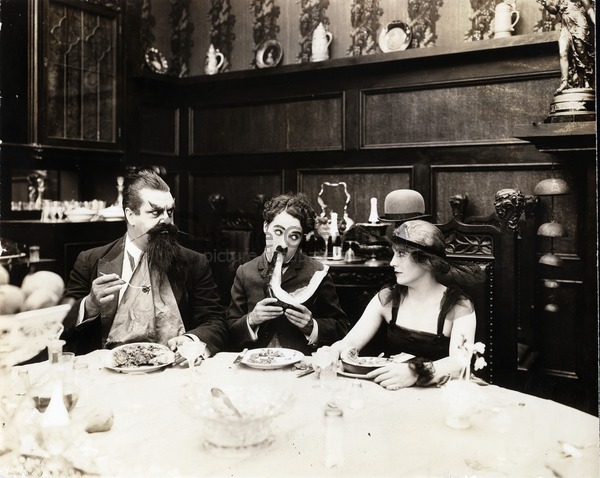
Although Chaplin directed his actors as if he were playing every part, he wanted an excellent ensemble of performers. He engaged Edna Purviance, his leading lady from Essanay, for effective underplaying to complement his own performances. Eric Campbell, who stood six feet four inches and weighed nearly 300 pounds, was engaged to be the “heavy” (Chaplin, by comparison, stood five feet six and one half inches and weighed 125 pounds during this period). Campbell had worked for Karno, where he had first met Chaplin, and was playing on Broadway in Pom Pom at the Cohan Theatre when Sydney Chaplin saw him during a visit to New York in 1916 to negotiate his brother’s contract with Mutual. Shortly thereafter, Chaplin asked Campbell to sign an agreement with Lone Star. A shy, gentle man in real life, the hulking Campbell was the perfect Goliath for Chaplin’s David. Yet the association between the two men, although immortal in film comedy, was short-lived. The last film in the Mutual series, The Adventurer, was Campbell’s last screen appearance. Campbell was killed instantly in a car accident on December 20, 1917, in Los Angeles at the age of thirty-seven.

Others in the Chaplin company were Karno alumni Albert Austin and John Rand, as well as character actors Leo White and Henry Bergman. Chaplin also hired Charlotte Mineau to portray mature and female “heavy” roles and Lloyd Bacon to play young men (Bacon later became a successful film director). Of course, Chaplin’s ensemble was merely support for his own protagonist in each film.

Chaplin was considered a somewhat solitary figure in Hollywood during the Mutual period. Instead of reveling in the pleasures of early Hollywood, Chaplin remained engrossed in his work and focused on expanding his career. Purviance was his constant companion, and he spent most evenings dining with her at the Los Angeles Athletic Club, where Chaplin was then living. She was a placid, calming force during his most turbulent moods and provided him unconditional love and stability in his otherwise chaotic, non-stop working life and through the strain of his stupendous worldwide celebrity. He gave her his affection, a career, and intellectual stimulation. Chaplin remembered that the two “were serious about each other, and at the back of my mind I had an idea that some day we might marry, but I had reservations about Edna. I was uncertain of her, and for that matter uncertain of myself.” (9)

During this period, Chaplin improved his standard of living for the first time in any significant way since he began in films. He purchased his first car, a Locomobile, and engaged a valet, Tom Harrington, and a chauffeur, Kono Toraichi. His social activities were confined during this period to people within his profession. His only routine pleasures were watching Jack Doyle’s Friday night boxing matches in Vernon, attending an evening of vaudeville at the Orpheum Theatre or the Morosco Theatre’s stock-company productions, or taking in an occasional symphony at Clune’s Philharmonic Auditorium. Chaplin recalled, “But writing, acting and directing fifty-two weeks in the year was strenuous, requiring an exorbitant expenditure of nervous energy. At the completion of a picture I would be left depressed and exhausted, so that I would have to rest in bed for a day” (10)

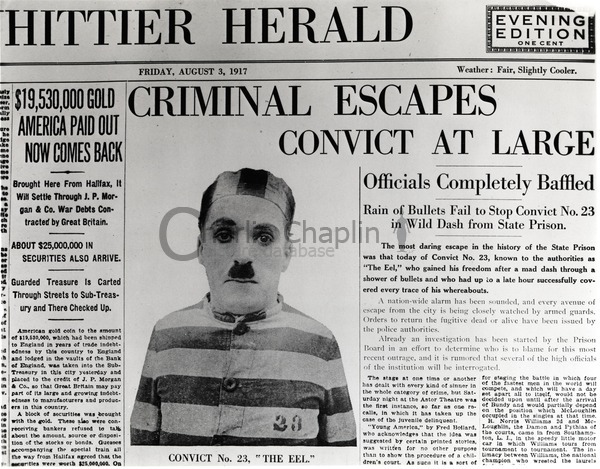
Chaplin departs from the Tramp costume in several of the Mutuals. He portrays a firefighter in The Fireman, a drunken man-about-town in evening clothes in One A.M., a drunk sporting a boater hat in The Cure, a police officer in Easy Street, and a prisoner in uniform and later disguised in evening clothes in The Adventurer. Chaplin’s willingness to try new ideas and approaches in these films is apparent in their unyielding inventiveness, further evidence of the freedom Mutual had given him to experiment and his own confidence in his range as an actor.
The Mutuals progressively demonstrate greater character development, cinematic technique, and more unified narrative structures. Specific locations or props, around which Chaplin builds his story and the gags that flow from it, become important characters themselves in the films. Whether an escalator in The Floorwalker, a fire station in The Fireman, a film studio in Behind the Screen, a pawnshop in The Pawn Shop, a roller-skating rink in The Rink, the dilapidated T-shaped street in Easy Street, the sets play pivotal roles in their respective films.

Throughout the Mutuals, Chaplin displays his unparalleled ability to combine brilliant, spontaneous improvisation with precise timing. He appears able to do anything—roller skate, slide down a fire the pole, climb the side of a cliff—with superhuman ease, dexterity, and grace. Chaplin infuses the Mutual films with moments of spontaneous pirouettes and androgynous behavior, and even not-so-veiled references to homosexuality.

The Mutual films were so successful that many other comedians tried to copied them, thus expanding the motion picture medium. The popularity of the Chaplin films and the universal appeal of the Tramp character did much to legitimize the new medium in twentieth-century culture. An influential appreciation, written by the distinguished American actress Minnie Maddern Fiske and published in the penultimate issue of Harper’s Weekly at the time of The Floorwalker, hailed Chaplin as “a great comic artist, possessing inspirational powers and a technique as unfaltering as Réjane’s.” Fiske even addresses Chaplin’s apparent vulgarity by comparing him with comic geniuses such as Aristophanes, William Shakespeare, Henry Fielding, and Jonathan Swift. “Vulgarity and distinguished art can exist together,” she wrote. (11) Many other critics concurred, and Chaplin was soon a darling of the intelligentsia. “The egregious merit of Chaplin,” wrote T.S. Eliot, “is that he has escaped in his own way from the realism of the cinema and invented a rhythm. Of course, the unexplored opportunities of the cinema for eluding realism must be very great.” (12)
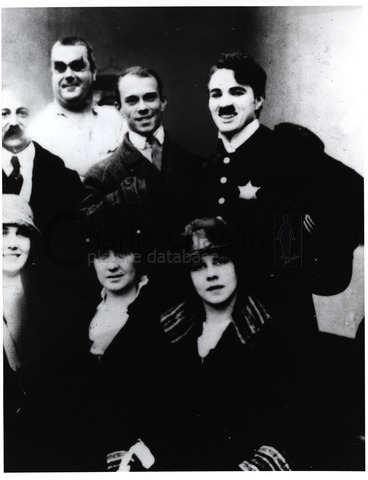
Chaplin was not only praised as a great artist; the public wanted to know more about Chaplin the man. Charlie Chaplin’s Own Story was written in 1915 by Rose Wilder Lane, then a journalist, who interviewed Chaplin for a series of newspaper articles that she later extended into a book. Much of the book was factually incorrect, reading more like Oliver Twist than an accurate account of Chaplin’s early life. Soon after it was published in 1916, Chaplin succeeded in suppressing the spurious autobiography on the grounds that it was “purely a work of fiction, holding him to public ridicule and contempt.” (13) The Tramp was the most recognizable representation of a human figure in the world. Once the fame of the real man enhanced the visibility of the role he created, Chaplin became the most famous person in the world. Critic Gilbert Seldes went so far as to write that Chaplin was “destined by his genius to be the one universal man of modern times.” (14)

The Floorwalker (Released: May 15, 1916)

The Floorwalker, Chaplin’s first film under his landmark contract with Lone Star-Mutual, has embezzlement as its subject. Chaplin’s inspiration for the film came while he and his brother Sydney were in New York City negotiating his contract with Mutual. While walking up Sixth Avenue at Thirty-third Street, Chaplin saw a man fall down an escalator serving the adjacent elevated train station and at once realized the comic possibilities of a moving staircase. He asked his technical director, Ed Brewer, to design and construct an escalator in a department store set designed by art director George (Scotty) Cleethorpe (who had worked for Chaplin at Essanay). “With a bare notion I would order sets, and during the building of them the art director would come to me for details, and I would bluff and give them particulars about where I wanted doors and archways.” Chaplin wrote in his autobiography, “In this desperate way I started many a comedy.” (15) After seeing The Floorwalker, Mack Sennett commented, “Why the hell didn’t we ever think of a running staircase?” (16)

The Floorwalker has none of the pathos, romance, or irony of the best Chaplin Mutuals. The crudeness and cruelty of his earlier films is still evident in The Floorwalker, although the film contains a stronger plot than most of his previous films, and the moving-staircase chase was novel for 1916. A glimpse of Chaplin’s evolution to a more graceful type of screen comedy is evident in Charlie’s dance when he discovers the valise of stolen money and dives into the bag. (This dance of joy ends with the manager choking him). Audiences were amazed and delighted by Chaplin’s brilliant antics. Yet he was determined to develop a new dimension to film comedy, the beginnings of which evolve in his third Mutual release, The Vagabond.

The Fireman (Released: June 12, 1916)

In Chaplin’s second effort for Mutual, he portrays an inept firefighter at Fire Station 23. Charlie, still asleep, mistakes a drill bell for a fire alarm and single-handedly drives out the horse-drawn fire engine. When he discovers his error, he simply backs up the engine into the fire station, with horses galloping backward (an early instance of camera tricks—cameramen Foster and Totheroh skillfully cranked the cameras in reverse and Chaplin staged the action backward).

The Fireman was filmed partly at an actual fire station, and two condemned houses were burned to provide authenticity. Despite its high production values, the two-reel comedy was no more sophisticated than Chaplin’s earlier films; the firefighters in the film are reminiscent of the antics of the Keystone Cops or a musical comedy chorus.

The Fireman, like The Floorwalker, shares the knockabout comedy of the Essanay films. Chaplin had produced a film carefully tailored to what he felt was public expectation. He then received a letter from an admirer who had seen The Fireman at a large Midwestern cinema and conveyed his disappointment. It was perhaps one of the most important letters he received in his career:

I have noticed in your last picture a lack of spontaneity. Although the picture was unfailingly as a laugh-getter, the laughter was not so round as at some of your earlier work. I am afraid you are becoming a slave to your public, whereas in most of your pictures the audiences were a slave to you. The public, Charlie, likes to be slaves. (17)

It was a great lesson to Chaplin. For the rest of his career, he trusted and adhered to his own ideas and likes rather than attempting to speculate on the perceived preferences of the public.

The Vagabond (Released: July 10, 1916)

The Vagabond, Chaplin’s third Mutual film, was an important step in Chaplin’s career, in which he interweaves pathos as an integral part of the comedy. Indeed, The Vagabond is the prototype of The Kid (1921) and The Circus (1928). Chaplin employs the same romantic triangle seen in The Tramp (1915) that he would revisit again in Sunnyside (1919) and The Circus. He imposed an unlikely happy ending on The Vagabond, in which the gypsy drudge demands that the car she is being taken away be turned around to bring Charlie along with her.

Legend has it that Chaplin originally intended the film to end with a scene in which Charlie attempts a watery suicide, is saved by an ugly farm woman, and plunges in again after one look at his rescuer (18). However, the few surviving outtakes from the film do not substantiate this claim. (19)

The Vagabond relies less on outright comedy than Chaplin’s earlier work. His direction of the film shows sensitivity and restraint in his treatment of the melodramatic material, such as the dramatic device of the lost child finally identified by her unique birthmark. Chaplin’s performance reveals great warmth and depth.

Strains of The Vagabond appear in many of Chaplin’s later films. The film’s ambiguous ending regarding Charlie’s future with the girl and his care of her foreshadows Charlie’s future relationship with Jackie Coogan in The Kid. The cruel gypsy chief is the precursor of the cruel step-father of The Circus. The scenes in the film of Charlie as the violinist (particularly Charlie, in a musical frenzy, falling into a tub of water) anticipate Limelight (1952). The Vagabond clearly shows Chaplin’s development of the film elements that Chaplin would use throughout his career, particularly the blending of comedy and drama.

One A. M. (Released: August 7, 1916)

One A.M., Chaplin’s fourth Mutual, is an impressive piece of virtuosity, a solo performance except for a brief appearance by Albert Austin as a taxi driver. The film is a tour de force of Chaplin’s superb pantomime and comic creativity performed in a restricted space, a brilliant experiment that he never repeated. Chaplin reportedly remarked, “One more film like that and it will be goodbye Charlie.” (20) The film’s simple situation revolves around a drunken gentlemen as he arrives home early one morning and tries to get upstairs into bed. The bed sequence anticipates Buster Keaton’s use of such props—the yacht of The Boat (1921), the steamship in The Navigator (1924), and the train engine in The General (1926)—and Chaplin’s own treatise of humanity trapped in a world of machines, Modern Times (1936). Art director Scotty Cleethorpe designed the splendidly surreal set, and technical director Ed Brewer created the folding bed that Chaplin turned into a memorable foil.

The film is not only a remarkable experiment, but also an invaluable record of Chaplin’s famous drunken character, earlier seen in the Fred Karno sketch Mumming Birds. He described what he thought made this type of drunk humorous in an article entitled “What People Laugh At,” published in American Magazine in 1918:

Even funnier than the man who has been made ridiculous…is the man who, having had something funny happen to him, refuses to admit that anything out of the way has happened, and attempts to maintain his dignity. Perhaps the best example is the intoxicated man who, though his tongue and walk will give him away, attempts in a dignified manner to convince you that he is quite sober.

He is much funnier than the man who, wildly hilarious, is frankly drunk and doesn’t care a whoop who knows it. Intoxicated characters on the stage are almost always “slightly tipsy” with an attempt at dignity because theatrical managers have learned that this attempt at dignity is funny. (21)

The Count (Released: September 4, 1916)

The fifth film in the Mutual series, The Count, further develops the situations of Caught in a Cabaret (1914) and A Jitney Elopement (1915) and anticipates the future Chaplin films The Rink, The Idle Class (1921), and City Lights (1931), films in which Charlie impersonates a man of means in order to underscore the contrast between rich and poor—one of his favorite themes. The film was Chaplin’s largest production up to that time, with three substantial sets (the tailor’s shop, the kitchen, and Miss Moneybags’ home). For the film’s dance sequence, Chaplin hired a small orchestra. The slippery dance floor facilitates some memorable eccentric dancing from Charlie, including splits and elevations done by hooking his cane on the chandelier above him.

The Pawnshop (Released: October 2, 1916)

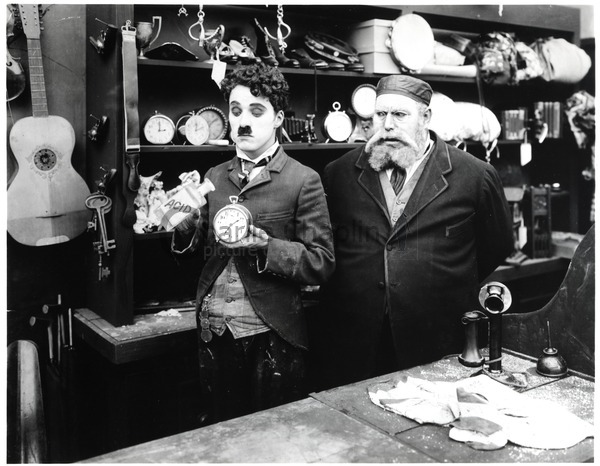
In the sixth Mutual film, Charlie is a pawnbroker’s assistant in a pawnshop that evokes the London of Chaplin’s childhood. The film is rich in comic transposition, a key element to Chaplin’s genius. The apex of such work in the Mutuals is the celebrated scene in The Pawnshop in which Charlie examines an alarm clock brought in by a customer (Albert Austin). Playwright Harvey O’Higgins cited the sequence as an ideal illustration of “Charlie Chaplin’s Art” in the February 3, 1917 issue of The New Republic:

He is a clerk in a pawnshop, and a man brings in an alarm clock to pledge it. Charlie has to decide how much it is worth. He sees it first as a patient to be examined diagnostically. He taps it, percusses it, puts his ear to its chest, listens to its heartbeat with a stethoscope, and while he listens, fixes a thoughtful medical eye on space, looking inscrutably wise and professionally self-confident. He begins to operate on it--with a can-opener. And immediately the round tin clock becomes a round tin can whose contents are under suspicion. He cuts around the circular top of the can, bends back the flap of tin with a kitchen thumb then, gingerly approaching his nose to it, sniffs with the melancholy expression of the packing houses. The imagination is accurate. The acting is restrained and naturalistic. The result is a scream. And do not believe that such acting is a matter of crude and simple means. It is as subtle in its naturalness as the shades of intonation in a really tragic speech. (22)

The sequence with the alarm clock in some ways prefigures Chaplin’s most celebrated use of comic transposition, the famous scene in The Gold Rush (1925) in which Charlie treats his old boiled boot in every detail as if it were a delicious Thanksgiving feast.

The pawnbroker was played by Henry Bergman in his first film for Chaplin. Bergman became an indispensable member of Chaplin’s team, appearing in every subsequent film up to Modern Times and remaining on the Chaplin Studios payroll until his death in 1946.

Behind the Screen (Released: November 13, 1916)

A refinement of his earlier comedies set in a film studio (A Film Johnnie and The Masquerader for Keystone in 1914 and His New Job for Essanay in 1915), Behind the Screen, Chaplin’s seventh film for Mutual, lampoons the unmotivated slapstick of the kind Chaplin disliked when he worked for Mack Sennett. Chaplin made the film as a sort of parody of the knockabout, pie-throwing comedy of the Keystone films.

An aspiring actress (Edna Purviance), desperate for work, disguises herself as a boy and is hired at the studio as a stagehand when the regular crew strikes (the strikers and their plans to blow up the studio are reminiscent of Dough and Dynamite [1914]). Charlie, discovering that the new stagehand is in fact a girl, gently kisses her just as Goliath (Eric Campbell) enters. “Oh you naughty boys!” Goliath remarks in an intertitle, as he teasingly pinches their cheeks and dances about in an effeminate manner before offering his backside to Charlie, which Charlie promptly kicks. This curious scene representing a homosexual situation is highly unusual in American commercial cinema for its time.

The Rink (Released: December 14, 1916)

Chaplin’s eighth film for Mutual, The Rink, is one of his most popular comedies. Charlie is an inept waiter who prepares the bill of Mr. Stout (Eric Campbell) by examining the soup, spaghetti, melon stains and other remnants on the sloppy eater’s shirt front, tie, and ear. Charlie employs an unorthodox approach to his work. He shakes an unusual cocktail; his whole body does a shimmy while the cocktail shaker remains immobile in his hands. He carelessly places a broiler cover over a live cat that he serves to a startled diner. Yet, inept as Charlie is as a waiter, he is incredibly graceful on roller skates, which is how he spends his lunch break.

Chaplin developed his skating skills while employed by Fred Karno in the British music halls, and the film was superficially inspired by the Karno sketch Skating (which had been partly written by Sydney Chaplin). Chaplin did all of the skating himself. He was occasionally aided by wires for shots which required Charlie to appear as if he were about to fall backward or forward while on skates, causing pandemonium in the rink. His agility and grace make The Rink one of his most memorable early comedies.

Easy Street (Released: February 5, 1917)

Chaplin’s last four Mutual-Chaplin Specials are among his finest work. While each of the preceding Mutual comedies took approximately one month each to make, Chaplin took more time with the last four (ten months in total), which extended his twelve-month period to approximately eighteen months. For Easy Street, his ninth film for Mutual and the most famous of the twelve, Chaplin ordered the first of the T-shaped street sets to be built that he would consistently utilize to provide a perfect backdrop to his comedy. The look and feel of Easy Street evoke the South London of his childhood (the name “Easy Street” suggests “East Street,” the street of Chaplin’s birthplace). Poverty, starvation, drug addiction, and urban violence—subjects that foreshadow the social concerns in his later films—are interwoven in “an exquisite short comedy” wrote critic Walter Kerr, “humor encapsulated in the regular rhythms of light verse.” (23)

In 1930 Chaplin told Russian film director Sergei Eisenstein that the scene in Easy Street in which Charlie scatters food from a box to a group of poor children as if they were chickens was indicative of his dislike for children. “You see, I did that because I despise them. I don’t like children,” he said. Eisenstein, who was not surprised by the remark, noted that those who normally do not like children are other children. (24) Chaplin was, in fact, intimidated and felt rather inferior to children. He wrote of children: “Most of them have assurance, have not yet been cursed with self-consciousness. And one has to be very much on his best behavior with children because they detect our insincerity.” (25)

All of the action in Chaplin’s films was carefully choreographed. As a result, there were no injuries to the cast while making the films, with the exception of a minor accident involving Chaplin on December 16, 1916, during the filming of Easy Street. He recalled, “We had one accident in that whole series. It happened in Easy Street. While I was pulling a street-lamp over the big bully to gas him, the head of the lamp collapsed and its sharp metal edge fell across the bridge of my nose, necessitating two surgical stitches.” (26) The injury also held up production, as the stitches prevented him from wearing makeup for several days. The injury, the size of the production, and a particularly rainy season in Hollywood contributed to a delay in the release of the film. Upon its release, Easy Street was hailed as a watershed moment in Chaplin’s career.

The Cure (Released: April 16, 1917)

The Cure, the tenth film in the series, is perhaps the funniest of the Mutuals. It was partly inspired in its setting by the Fred Karno sketch, The Hydro, which was set in a hydrotherapy clinic. Further inspiration for the film was drawn from the Los Angeles Athletic Club, where Chaplin was living at the time and where the idea of a health spa first occurred to him. The wrestling bouts in the gymnasium of the Athletic Club caught his imagination and inspired the scene in the film in which Charlie wrestles the masseur.

Completion of the film was again delayed because of Chaplin’s quest for perfection. Outtakes survive showing that the film began quite differently, with Charlie intending to play a bellman and later a spa attendant in a health resort before finalizing on the inebriate character. Production was further delayed when Chaplin caught a chill after filming some of the water scenes.

Chaplin’s use of dance in The Cure is also notable. There is a delightful scene in the changing room where Charlie assumes several poses in his swimsuit as the curtains open and close before he dances along to the pool. The scene was inspired by the tableaux vivants, a popular feature of many British music-hall programs.

The Immigrant (Released: June 17, 1917)

The Immigrant, which contains elements of satire, irony, and romance as well as cinematic poetry, endures in the twenty-first century as a comic masterpiece. The film, Chaplin’s eleventh in the Mutual series, is the best-constructed of his two-reelers and was Chaplin’s favorite among all his two-reel comedies

The original idea for the film was a variation of Trilby set in the Latin Quarter of Paris, which evolved into a comedy about two immigrants who meet on a boat, part ways, and are reunited by a chance encounter, a menacing waiter, and an artist’s enthusiasm. Chaplin had shot as much footage on The Immigrant as most directors would to photograph a feature-length production. In his efforts to continuously refine the film, he exposed more than 90,000 feet of negative (the finished film runs approximately 2,000 feet), and he went four days and nights without rest while editing the film to final length.

In devising The Immigrant, Chaplin drew on his own experiences immigrating to the United States and attempted to find the humor in otherwise traumatic aspects of coming to a new land. Chaplin conjures many funny gags out of the hardships of an Atlantic passage on an immigrant vessel. These gags were enhanced by the rocking effect of the boat itself, which was partly achieved by a heavy pendulum that was fitted to the camera head. Totheroh put the camera on a special tripod that allowed it to rock from side to side. Once the ship moved, the camera moved as well. The rocking interior of the dining hall was a studio set built on rockers. With the rocking effect perfected, Chaplin was free to fashion every seasick gag imaginable. He also found material for the film in his experience as an outsider careful with his money upon his arrival to America. During that time, Chaplin was intimidated by waiters and realized that others shared similar feelings. This fear was the spark for the café sequence.

Chaplin was justifiably pleased with the film’s opening gag, which contained the element of surprise. He wrote in 1918:

Figuring out what the audience expects, and then doing something different, is great fun to me. In none of my pictures, The Immigrant, the opening scene showed me leaning far over the side of a ship. Only my back could be seen and from the conclusive shudders of my shoulders it looked as though I was seasick. If I had been, it would have been a terrible mistake to show it in the picture. What I was doing was deliberately misleading the audience. Because, when I straightened up, I pulled a fish on the end of a line into view, and the audience saw that, instead of being seasick, I had been leaning over the side to catch the fish. It came as a total surprise and got a roar of laughter. (27)

The gag foreshadows a similar gag in the most celebrated moment in The Idle Class, in which Chaplin, with his back to the camera, appears to be sobbing, yet when he turns around, he is actually mixing himself a drink with a cocktail shaker.

Undertones of social criticism are suggested in The Immigrant, the first of many Chaplin films to contain such themes, which were seldom found in comedy films of this period. For instance, when the immigrants first see the Statue of Liberty the immigration officials rope all the foreigners together like cattle, causing Charlie to cast a quizzical second look at the land of the free. When an immigration officer turns away from Charlie, Charlie kicks him in the backside. Carlyle Robinson, Chaplin’s publicity director, joined the Lone Star Studio on the day the dailies of this sequence were being screened. Chaplin asked his new employee what he thought of them.

          “Very funny and very realistic,” Robinson replied.

          “Do you find anything shocking in it?”

          “Not that I can recall.”

Apparently, the social criticism issue had been raised by one of Chaplin’s associates, and Robinson’s answer satisfied Chaplin. As Robinson affirmed, “The scene was kept in the final version of the film and there was never the least complaint.” (28) Indeed, the critics were not put off by traces of social commentary in the film. Julian Johnson wrote in Photoplay, “In its roughness and apparent simplicity it is as much a jewel as a story by O. Henry, and no full-time farce seen on our stages in years has been more adroitly, more perfectly worked out.” (29)

The Immigrant also is significant in Chaplin’s evolution as a filmmaker because it is the first film in which his character embarks upon a full-fledged romantic relationship. To help evoke a romantic mood on the set, Chaplin—like many filmmakers of the silent era—employed “mood” musicians to play music off-camera while scenes were being filmed. Chaplin wrote in his autobiography, “Even in those early comedies I strove for mood; usually music created it. An old song called ‘Mrs. Grundy’ created the mood for The Immigrant. The tune had a wistful tenderness that suggested two lonely derelicts getting married on a doleful, rainy day.” (30)

Chaplin retained a special place in his memory for the film. He wrote in My Life in Pictures, “The Immigrant touched me more than any other film I made. I thought the end had quite a poetic feeling.” (31)

The Adventurer (Released: October 22, 1917)

Chaplin and his brother Sydney went to San Francisco for a vacation after completing The Immigrant. Chaplin was growing tired from the hectic pace of the series; four months passed before the last film, The Adventurer, was released—the longest interval between films for Chaplin in his entire career up to that time.

The most popular of the Mutuals, The Adventurer begins and ends with a chase. It is the fastest-paced film of the series, and although it has more slapstick than Easy Street and The Immigrant, it is redeemed by its construction, characterization, and Chaplin’s balletic grace.

A famous moment in the film has Charlie spilling ice cream down the front of his over-sized trousers. Chaplin wrote a detailed analysis of the scene in his article, “What People Laugh At”:

All my pictures are built around the idea of getting me into trouble and so giving me the chance to be desperately serious in my attempt to appear as a normal little gentleman. That is why, no matter how desperate the predicament is, I am always very much in earnest about clutching my cane, straightening my derby hat and fixing my tie, even though I have just landed on my head.

I am so sure of this point that I not only try to get myself into embarrassing situations, but I also incriminate the other characters in the picture. When I do this, I always aim for economy of means. By this I mean that when one incident can get two big, separate laughs, it is much better than two individual incidents. In The Adventurer I accomplish this by first placing myself on a balcony, eating ice cream with a girl. On the floor directly underneath the balcony, I put a stout, dignified, well-dressed woman at a table. Then, while eating the ice cream, I let a piece drop off my spoon, slip through my baggy trousers, and drop from the balcony onto this woman’s neck.

The first laugh came at my embarrassment over my own predicament. The second, and the much greater one, came when the ice cream landed on the woman’s neck and she shrieked and started to dance around. Only one incident had been used, but it had got two people into trouble and had also got two big laughs.

Simple as this trick seems, there were two real points of human nature involved in it. One was the delight the average person takes in seeing wealth and luxury in trouble. The other was the tendency of the human being to experience within himself the emotions he sees on the stage or screen.

One of the things most quickly learned in theatrical work is that people as a whole get satisfaction from seeing the rich get the worst of things. The reason for this, of course, lies in the fact that nine tenths of the people in the world are poor, and secretly resent the wealth of the other tenth.

If I had dropped the ice cream, for example, on a scrubwoman’s neck, instead of getting laughs sympathy would have been aroused for the woman. Also, because a scrubwoman has no dignity to lose, the point would not have been funny. Dropping ice cream down a rich woman’s neck, however, is, in the minds of the audience, just giving the rich what they deserve.

By saying that human beings experience the same emotions as the people in the incidents they witness, I mean that—taking ice cream as an example—when the rich woman shivered the audience shivered with her. A thing that puts a person in an embarrassing predicament must always be perfectly familiar to an audience, or else the people will miss the point entirely. Knowing that the ice cream is cold, the audience shivers. If something else was used that the audience did not recognize at once, it would not be able to appreciate the point as well. On this same fact was based the throwing of custard pies in the early pictures. Everyone knew that custard pie is squashy and so was able to appreciate how the actor felt when one landed on him. (32)

Other highlights from the film include Charlie donning a lampshade and freezing in position as the guards run past him and a chase in which he dodges a prison guard and the rival by using sliding double doors which become, in turn, a head-stock, a moveable wall, and an escape route.

It is ironic that in his last film of the demanding Mutual series Charlie escapes from prison. In contrast with Essanay, Chaplin’s relationship with the Mutual Film Corporation ended amicably. Indeed, Mutual offered him a million dollars for eight more films, but Chaplin sought even greater independence. Chaplin later wrote, “Fulfilling the Mutual contract, I suppose, was the happiest period of my career. I was light and unencumbered, twenty-seven years old, with fabulous prospects and a friendly, glamorous world before me.” (33)

The Mutual-Chaplin Specials were frequently revived theatrically, non-theatrically, and in prints sold to libraries and for home use. Chaplin’s son Sydney remembered watching some of the Mutual comedies with Jerry Epstein at the Silent Movie Theatre in Hollywood in the late 1940s. They enjoyed the films, but not nearly as much as the man several rows behind them, who was manically and uncontrollably laughing. When the show ended and the two turned to investigate, they discovered the laughter was from Chaplin himself. “It was my father who was laughing the loudest! Tears were rolling down his cheeks from laughing so hard and he had to wipe his eyes with his handkerchief. He was sitting with Oona. He had brought her to the Silent Movie because she hadn’t seen any of them before.” (34)

Perhaps Chaplin had such a fondness for the Mutuals because, in many ways, the films serve as a foundation for all that would follow in Chaplin’s remarkable career. Chaplin’s prior films, although wonderful in their time, failed to ignite the cinematic alchemy that would come to be called “Chaplinesque”—the blending of comedy, pathos, and social commentary into a single narrative whole, as seen in The Vagabond, Easy Street, and The Immigrant and in all of Chaplin’s best films thereafter. No other filmmaker had consistently injected this combination of elements with such an exquisite level of skill into a comedy film. The Mutual films are extraordinary because they represent the only period in Chaplin’s career during which he allowed himself to revel in rather than to revile the creative process, to tinker in his comedic laboratory, resulting in some of the finest work of his career. A testament to the enduring quality of the Mutuals is not only that others appropriated sequences from the films (including Chaplin’s contemporaries Harold Lloyd and Buster Keaton, and later comedians such as the Marx Brothers), but that Chaplin himself often borrowed liberally from the Mutuals in his later, more sophisticated films. Perhaps he had great fondness for the Mutuals simply for the same reason that generations of audiences have as well—because of the sheer joy, comic inventiveness, and hilarity of this extraordinary series of films.

Endnotes

  1. Terry Ramsaye in Reel Life, the Mutual Film Corporation’s publicity magazine, March 4, 1916.
  2. “Chaplin Signs with Mutual,” Moving Picture World 27, no. 10 (March 11, 1916).
  3. Charles Chaplin, My Autobiography (London, 1964), p. 162.
  4. Richard Roud, “The Baggy-Trousered Philanthropist,” The Guardian, December 28, 1977, p. 3.
  5. Lady Chaplin to David Robinson, in David Robinson, Chaplin: His Life and Art (London, 2001), xix and p. 664.
  6. Chaplin’s working method was explored in the three-part documentary Unknown Chaplin (1983).
  7. Roland Totheroh, “Roland H. Totheroh Interviewed: Chaplin Films,” in Timothy J. Lyons, ed., Film Culture 53-55 (spring 1972), p. 239-241.
  8. Terry Ramsaye, “Chaplin—and How He Does It,” Photoplay 22, no. 4 (September 1917), p. 22.
  9. Chaplin, My Autobiography, p. 219.
  10. Ibid., p. 221.
  11. Minnie Maddern Fiske, “The Art of Charles Chaplin,” Harper’s Weekly 62 (May 6, 1916), p. 494.
  12. Eliot, quoted in Gilbert Seldes, The Seven Lively Arts (New York, 1924), p. 361.
  13. Letter from Chaplin’s attorney Nathan Burkan to Bobbs Merrill’s attorneys Lockwood and Jeffery, October 1, 1916 in the Chaplin Archives.
  14. Gilbert Seldes, Movies for Millions (London, 1937), p. 37.
  15. Chaplin, My Autobiography, p. 222.
  16. Ibid., p. 201.
  17. Chaplin, “Does the Public Know What It Wants?,” Adelphi 1, no. 8 (January 1924), p. 705. Chaplin vividly recalled the letter fifty years later in 1 1966 interview with Richard Meryman.
  18. Theodore Huff, Charlie Chaplin (New York, 1951), p. 71.
  19. Four hundred twenty-three reels (approximately seventy hours) of Chaplin outtakes, filmed visitors to the studio, and tests—most from the Mutual-Chaplin Specials—have been preserved by the BFI National Archive.
  20. Huff, p. 71.
  21. Chaplin, “What People Laugh At,” American Magazine 86 (November 1918), p. 136.
  22. Harvey O’Higgins, “Charlie Chaplin’s Art,” The New Republic 10, no. 118 (February 3, 1917), p. 17.
  23. Walter Kerr, The Silent Clowns (New York, 1975), p. 95.
  24. Sergei M. Eisenstein, “Charlie the Kid,” Sight and Sound 15, no 57 (spring 1946), p. 14.
  25. Chaplin, My Trip Abroad (New York, 1922), p. 22.
  26. Chaplin, My Autobiography, p. 202.
  27. Chaplin, “What People Laugh At,” p. 136.
  28. Carlyle T. Robinson, La verité sur Charlie Chaplin: sa vie, ses amours, ses déboirs, translated by René Lulu (Paris, 1935), p. 18.
  29. Julian Johnston, “The Shadow Stage” (review of The Immigrant), Photoplay 12, no. 4 (September 1917), p. 99-100.
  30. Chaplin, My Autobiography, p. 225.
  31. Chaplin, My Life in Pictures (London, 1974), p. 150.
  32. Chaplin, “What People Laugh At,” p. 134.
  33. Chaplin, My Autobiography, p. 202.
  34. Sydney Chaplin in an interview with Jeffrey Vance, 1998 and corroborated by Jerry Epstein, in an interview with Jeffrey Vance, 1991.