CALL FOR PAPERS | CHAPLIN NOW: 50 YEARS ON
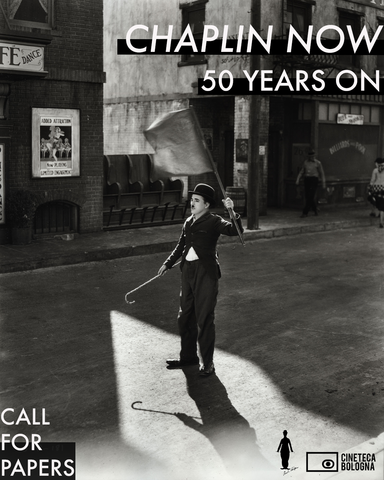
CALL FOR PAPERS | CHAPLIN NOW: 50 YEARS ON
Conference | June 17, 18 and 19, 2027
Cineteca di Bologna, Italy
Statement of Intent
2027 marks fifty years since the death of Charles Chaplin on 25 December 1977, and seventy-five years since the release of Limelight (1952). Fifty years on, what is there still to discover about Chaplin?
Quite a lot.
Thirteen years after our last conference The Birth of Chaplin’s Little Tramp, we find ourselves in a very different landscape of Chaplin research. Digital resources have opened access to sources that were once difficult or impossible to consult, from local newspapers and trade publications to magazines and archives in Arabic, Hindi, Farsi and many other languages. At the same time, numerous collections, large and small, have passed to new owners or heirs, bringing previously unknown or inaccessible material to light.
The Chaplin Archive is a living archive. Its holdings continue to grow, while the ongoing work of cataloguing, digitising and making its collections accessible is opening new possibilities for research. Over the past fifteen years, the online database www.charliechaplinarchive.org has become an indispensable tool for scholars, historians, and documentary filmmakers seeking new perspectives, previously unexplored material, and the depth of documentation required for truly rigorous research.
These developments allow us both to move beyond subjects that have been extensively explored and to return to familiar questions with new sources and fresh perspectives. They make it possible to look beyond the established centres of Chaplin scholarship and to ask how his films, his image and his ideas travelled, were translated, adapted, embraced – and sometimes rejected – around the world.
CHAPLIN NOW: 50 YEARS ON takes its title from a simple observation: Chaplin is not only a figure of the past. His films continue to be restored, rediscovered and reinterpreted; his work continues to be taught, screened and debated; and his image continues to appear not only on cinema screens and streaming platforms, but in classrooms, museums, protests, street art, popular culture and social media.
Fifty years after his death, Chaplin remains remarkably present. We invite proposals that explore how and why he endures – and what new research can tell us about a figure whose cultural afterlife has proved as complex and international as his original career. Behind this call lies a conviction: that cinema can change the world, and that looking closely at how it has done so is one of the best ways to understand what it might still do.
The conference is designed primarily for a general public, while welcoming film scholars, researchers, archivists, curators, educators and enthusiasts. We particularly welcome proposals that are historically grounded, culturally engaged and accessible to a broad audience, without requiring a purely theoretical or conventionally academic approach.
We invite new archival discoveries; research based on local, regional and underused sources; studies of circulation and reception; teaching and curatorial experiences; digital projects; and artistic responses. We are especially interested in approaches that open new ways of seeing Chaplin and that bring overlooked people, places, sources and histories into the conversation.
While this is not a requirement, we particularly welcome projects that make use of the Chaplin Archive website and its digitised collections. The conference also provides an opportunity to celebrate the long collaboration between the Cineteca di Bologna and Roy Export (the Chaplin Office), and the Cineteca’s work to catalogue and digitise the Chaplin Archives and make them increasingly accessible to researchers and the public.
The conference will take place in Bologna on 17–19 June 2027, immediately preceding Il Cinema Ritrovato (19–27 June 2027), and will form part of the festival’s opening program. https://ilcinemaritrovato.it/en/
Provisional Keynote and Featured Speakers (Further Announcements to Follow) While we are still in the process of identifying our special guests and keynote speakers, we warmly invite you to submit your proposals.
Topics
The following topics are intended to suggest directions rather than limit the scope of the call. Proposals on any aspect of Chaplin’s life, work, reception or afterlife are welcome.
Learning to See Cinema through Charlie Chaplin: New Audiences, New Uses
Cinematheques, museums and other institutions with educational departments have long used Chaplin’s films to introduce children and young people to cinema. They do so through screenings, re-enactments, costume and disguise, music, and discussions that use comedy as a way of approaching subjects such as poverty, social exclusion and totalitarianism.
What happens when new generations encounter Chaplin? How are teachers, educators, cinematheques, museums and other institutions introducing his films to children and young people today? What happens when a generation raised on streaming platforms, smartphones and social media encounters a black-and-white silent film for the first time? What does Chaplin teach them—and what do their responses teach us?
We welcome reports on educational projects, workshops, teaching materials, screenings, exhibitions and digital resources and invite educators, archivists and teachers to present and share these experiences, with the aim of strengthening the remarkable international network that continues to demonstrate the enduring and unsurpassed power of Chaplin’s cinema.
When Charlie Crosses the Border
Chaplin is often described as a “universal” filmmaker because pantomime allowed his films to cross linguistic boundaries. Yet his global success may also lie in his extraordinary capacity to be translated, adapted and appropriated locally. The Tramp was absorbed into different cultural vocabularies and used to address specific social and political realities—from Cairo and Beirut to Tokyo, Tehran, Mexico City and beyond.
We welcome research on circulation, censorship, translation, local adaptations and political readings, as well as cases of rejection and resistance. In Japan, for example, the emerging Prokino movement defined itself in part against “Chaplinism” and its perceived petit-bourgeois politics. We especially encourage submissions from colleagues working in Africa, Asia, the Middle East, Eastern Europe and Latin America, particularly those bringing new archival sources and underrepresented perspectives on Chaplin’s circulation and reception to light.
Where proposals are of comparable interest and quality, and with the aim of ensuring that the conference reflects the multicultural perspectives at the heart of these questions, we will give preference to scholars from the countries and cultural contexts being discussed.
Chaplin after the Films: Images, Memes and Political Reappropriations
Even today, the figure of the Tramp and individual images from Chaplin’s work are constantly recirculated through memes, GIFs, clips and social media, acquiring meanings that remain immediately legible across very different contexts.
These images function almost like an already available visual vocabulary through which to articulate marginality, oppression, labour, resistance and the relationship between the individual and power. Their political and symbolic reactivation has taken place in radically different geographical settings.
We welcome proposals exploring Chaplin’s continuing presence in popular culture, protest, memes, street art and other contemporary forms, with particular reference to appropriation and political reactivation of Chaplin’s imagery, and asking why these century-old images continue to provide such an effective visual language for present-day struggles.
Underground Charlie: Censorship, Politics and Afterlives
Chaplin had an underground life as well as a public one. We invite research into bootleg distribution, unofficial screenings and the circulation of Chaplin’s films during periods when his work was restricted, censored or politically suspect—from Franco’s Spain to Cold War America and beyond. How did audiences encounter Chaplin when official channels were closed or restricted? How were his films interpreted within different political cultures? We also welcome proposals examining Chaplin’s later political and popular afterlives: from protest art and political cartoons to street culture, memes and other contemporary forms of expression.
Thinking Cinema through Chaplin
Chaplin was one of the decisive figures through whom critics began to establish cinema as an art and the filmmaker as an author. From Louis Delluc’s Charlot (1921), the first monographic study of Chaplin and an early extended critical study of a film artist, to Walter Benjamin’s discussion of The Circus as a mature work of cinematic art, Chaplin repeatedly became a test case for what cinema could be. In Italy, The Gold Rush prompted debate among writers including De Benedetti, Gadda and Montale; elsewhere, Kamel el-Telmissany’s Dear Charlie (1958) became an important text in early Arab film theory. We invite proposals exploring Chaplin’s place in film criticism and theory, and the ways critics, writers and philosophers have used him to think about cinema, authorship, comedy, spectatorship and the status of film as an art.
Who Made Chaplin?
Chaplin has long been presented as a total auteur, in control of virtually every aspect of his work. We know much more today about how he worked and about some of his best-known collaborators, but a fuller reconstruction of the professional ecosystem around him remains to be written. Assistants, secretaries, cameramen, editors, musicians, orchestrators, technicians, intermediaries, lawyers, publicists and many others made Chaplin’s work possible. In notes prepared for the press conference of A King in New York, Chaplin himself acknowledged the personal and professional value of his team. What can the archive reveal when we look at Chaplin’s films not only as the work of an exceptionally autonomous author, but also as the product of a complex system of labour and collaboration? The seventy-fifth anniversary of Limelight offers a fitting opportunity to explore these questions through the making of the film and the many people who worked on it. We welcome research on any period of Chaplin’s career that recovers overlooked people, relationships and forms of work with particular attention to the women who were part of his creative and professional circle.
The Actresses in Chaplin’s Films
Who were the women who appeared in Chaplin’s films, and what lives and careers did they have beyond the screen? Each of them left an indelible and unmistakable mark on the films they appeared in, even though several had little or no previous screen experience and, in some cases, did not pursue substantial film careers afterwards. This was not unique to Chaplin or to the period, but it was particularly characteristic of early and silent-era cinema, when performers could move into film from the stage, music hall, dance or other forms of popular entertainment without following the more continuous screen careers that later became associated with the star system.
We invite new research into actresses and other women who worked with, around or alongside Chaplin, drawing wherever possible on third-party archives, correspondence, newspapers and other sources that can recover lives and careers obscured by Chaplin-centred histories.
Chaplin at the Movies
What did Chaplin watch, admire, borrow, transform or reject? Which filmmakers influenced him? What films did he see? How did his encounters with cinema shape his own work, and how did he respond to the films and filmmakers around him?
Chaplin and Artists
Chaplin’s influence on generations of artists is well known, but the stories at the edges are not. Who were the lesser-known creators who crossed his path, corresponded with him, portrayed him or worked in his shadow? Who is drawing on Chaplin today—in contemporary art, comics, street art, music, theatre and film? We welcome proposals that bring new names, new documents and new connections to light, as well as studies of Chaplin’s continuing influence across artistic forms.
The Living Archive
We welcome research based on newly discovered or newly accessible archival material, as well as reflections on the processes of cataloguing, digitisation and digital access.
Charlie in the Pressbooks
Chaplin was among the first truly global celebrities, and he kept an extraordinary record of how he appeared in the press. How did Chaplin and his press office work with newspapers and magazines to launch films and construct an image of Chaplin as a man of the people? What does the press record—national, regional and local—tell us that official histories do not? And what can Chaplin’s extraordinary experience of celebrity teach us about fame today, in an age when the relationship between public figures, performers and their audiences has been radically transformed by new forms of media and communication?
“Our Charlie?” Chaplin, Britain and the World”
Chaplin’s relationship with Britain was marked by both extraordinary fame and persistent ambivalence, from the white feathers of the First World War era to his eventual knighthood. What place did Chaplin occupy in British culture and cinema between his departure for America and his death in 1977? How was he remembered, celebrated, criticised or claimed as “one of our own”?
Proposals All are welcome to submit proposals. Please send a 500-word abstract, a short bio and your contact information by December 22nd, 2026 to both Arnold Lozano (office@charliechaplin.com) and Cecilia Cenciarelli (Cecilia.Cenciarelli@cineteca.bologna.it).
Please place CHAPLIN NOW 2027 in your subject line.
Conference Organizers:
CINETECA DI BOLOGNA Gian Luca Farinelli (Director), Cecilia Cenciarelli (Archivist, Head of the Chaplin Project) Via Riva di Reno, 72, 40122 Bologna, Italy http://www.cinetecadibologna.it
ROY EXPORT S.A.S. Arnold Lozano (Director) 58 rue Jean-Jacques Rousseau, 75001 Paris, France www.charliechaplin.com
Not submitting? You do not have to present to attend. Whether you are a fan, collector, filmmaker, or simply curious, we hope to see you at the festival. Mark your calendars!